Friday, April 27, 2012

Capulamikas


For the past couple weeks I have been trying, unsuccessfully, to find the common thread between the sinking of the titanic, the declaration of the emancipation proclamation, an IRS deadline, and Alto Molocuean Passover. Water related deaths cover the titanic and Passover, but not the others. The federal government put the IRS and emancipation proclamation together, but again left two in the cold. Day of freedom could bring together all but the titatnic, unless you have a philosophical view of death. Try as I might, these 4 events shared only one strangely coincidental thread: April 15th


Ellen, Myself, Arielle and Dylan at the seder
Though the date commonly recognized as the time for the 5000-year-old-escaping-slavery -victory-party was more than a week before, Eliahu got to Alto Molocue a little late this year. Maybe it has something to do with the lack of Jews (10 in Peace Corps by my counting). Maybe it has something to do with the lack of matzah (only available if you make your own). Maybe it has something to do with the uncomfortable proximity to Gaza (province). Or maybe it has something to do with exam week falling on the same week as Passover. Whatever the reason, I spent global Passover eating 4 delicious egg, ketchup, and cheese (newly arrived to Alto Molocue!) sandwiches, but April 15th and 16th eating flavorless crackers.

On day before AMP (Alto Molocuean Passover) I left the breathtakingly beautiful Gurue, which I had come to for a JUNTOS (Peace Corps journalism group) conference, and made my way back to Alto Molocue in the company of Moz 17er Zackaria and Moz 16er Vincente. Sitting in the back of a pickup truck with about 20 other travelers, 2 chickens, 4 sacks of cement, 2 window frames, and a large piece of zinc roofing we made our way up the bumpy winding road. Due to the previous night's rain, the mud along the dirt road was quite bad. On two occasions the road was so slippery that everyone had to get out and push to make it up a hill. 2 sore ass cheeks latter, we arrived in Alto Molocue and made a brisk shopping trip (tomatoes, eggs, bread, sugar cane, and light bulbs) to prepare for the inundation of visitors from Cabo del Gado and Nampula provinces.

As this was the first time I was going to have a large group of volunteers at my house, I was quite nervous. Beyond the unusual jitters that come with being a host (clear directions, sufficient food, room to sleep, ect…) being a PCV adds a few more layers of stress. First, there is the problem of water. Where as in the US water is an effortless resource, any water I have here either requires a heavy rain or an exhausting trip to the pump. Hoping to avoid having to get water during the 3 days of visits, I had bought and filled an 80 litter balde (bucket) to supplement my already existing 150 litters of storage. Even so, 7 people drinking water, taking bucket baths, flushing toilets, cooking food, and washing plates used most of it up in a little over 24 hours. Luckily, I have the amazing Tojo to keep water in my house and my calm in my mind.

I'm a lumberjack and I'm ok,
I sleep all night and  I work all day
Another added stress is security. It is well known among PCVs that most security incidents happen when a large group of volunteers are together. Though I normally feel very safe at site, all the added attention that comes with having 6 more Americans in my house does change things. Hoping to avoid any incidents, I had spent the week before upgrading the security measures on my house. Knowing that a crocodile filled moat around my yard might make community integration a little difficult, I had to settle with putting up gates on the doors of my quintal, re-cementing the gelhas on my windows and doors, and making sure Coco was comfortable sleeping outside. Though these measures may not have done much in the event of an actual burglary, it put my mind at ease.

Harroset!
Feeling as prepared as I could be, I started walking up towards the paragem to welcome my guests to Alto Molocue. As if I had planned it, Ariel, Ellen, Patrick, Leah, and Christina all showed up just as I reached the highway. After allowing them to sample some off the finner things in Alto Molocue (soft serve ice cream) and taking them on a leisurely stroll through town (hike up a 10% grade hill with big bags), I brought them home. As requested, each guest had brought with them an ingredient for Passover, which they presented before our quick and easy dinner of spaghetti with sauce. After a couple round of beers from a local bar, we pushed furniture to the walls, turned the bed-sofa into a bed, and went to sleep.

Chicken's out of Coco's grasp
Monday found us awake and excited to start what would be the gross majority of our merry band’s first Passover (10 attendees, 3 Jews). To get all the ingredients for our feast, I went out with a small foraging party. Upon our triumphal return, we began cooking a Passover spread that would have made any Jewish mother proud. Chicken (first kills for Cristina and Ariel), matzah ball soup, harroset, homemade matzah, cacana (bitter herb), apple crisp, and friend rice alongside a giant balde of sangria to ensure that we all met the 4 drink minimum (check your hagada).


My fellow Jews Arielle and Ellen with their Capula
After distributing the capulamikas (capulana yamikas), everyone sat down and we began the seder. You should know that this wasn’t your grandfather's everything-in-hebrew-no-skipping-pages-wish-I’d-just-watched-the-rugrats-episode seder. This was a Sam Bar seder. And if you know anything about Sam Bar, you know he’s fast, and likes to talk in the third person. Though I would like to show you how it’s done, the extensive video recording system I set up never worked, so here are the highlights:


1) Tell the Passover story
     a. Jews building pyramids
     b. Moses to Pharaoh "Let my people go!"
     c. 10 plagues (voting is required)
     d. Pharaoh to Moses "I'm letting your people go"
     e. Pharaoh to himself "I shouldn't have let his people go"
     f. Chariot chase ends in Red Sea
     g. Moses to himself "Where should my people go?"
2) Four Questions
     a. Flavorless crackers
     b. Bitter herbs
     c. Condiments are awesome!
     d. Chillax the night away
3) Seder Plate
     a.  Egg
     b. Cacana (bitter herb)
     c. Dried Parsley
     d. Harroset
     e. Chicken Bone
     f. Wasabi (horse radish)
4) Drink wine and eat food

Despite the little mishap with the afikoman (one of the guests didn't understand that it was to be eaten latter, so they hid it in the toilet), everyone finished the night stuffed full of food and a little drunk on sangria. The next morning, we all packed our bags and headed to Nampula for the conference which takes place after 4 months at site for volunteers to compare notes and integration strategies, known as Reconnect. It’s also a great excuse to go shopping in Nampula for life’s essentials (peanut butter and duct tape).

Happy Belated Passover!

PS: I was unable to take any pictures of the Seder. Luckily, Ellen was snapping away and once I get the pictures from her, I will add them to the post.

Saturday, March 31, 2012

Mi Kiri Pama


One of the things you need to know about Peace Corps is that all volunteers start to find very strange combinations of words hilarious. This unique brand of comedy is so strange that each country has its own, exclusive brand of comedy. Saying “These are not the ladraoes you are looking for” and throwing things like “E possivl”, “Entao”, and “E o Nao e?” randomly into sentences wouldn't be funny to anyone else, but to me they’re hilarious. It’s to the point where the funniest thing I ever get to hear on a regular basis is “I am fine, and how are you?”  coming from the mouth of some random Mozambiquean. Yes, the weirdly accented vowels are funny, and the overly earnest expression on their faces makes you chuckle, but what it really comes down to is relief. Relief that the communication barrier you normally have to break down has been broken for you. Sure, it may be the full extent of their English, but at least you’re not left alone sounding stupid in Portuguese.

But at some point, you don’t sound so stupid in Portuguese. In fact, you feel pretty confident that you can get your point across as long as you can find a way to explain what you mean with a very limited vocabulary. That’s why local languages were created.

The cultural gods’ gift to me was Elomwe. Spoken only in the northeastern region of Zambezia Province, it sounds like nothing I’ve ever heard. Though there are elements of Portuguese woven in, all the words are strange and new, which has made it challenging but fun to learn. Thankfully Ionde e su caderno?” (where is your notebook) if I don’t have it out fast enough.

have my good buddy Machonichone. I'm not actually sure that that's his name, and since its way to complicated to remember, I just call him Professor. Every time I see him at his bagged cooking oil stand, he’s ready with a new word of phrase for me to learn. At first, I would try to just remember them by hearing them, but I found out that unless I write it down in a little notebook, it’s like it never happened ( I must be my mother’s son because). So then I started carrying around an “Elomwe” notebook to dorkily whip out every time I see him. It’s gotten to the point that Professor even follows up the new words with an exasperated “
Starting out with the general greeting (Mosheliwa), we worked our way through salt (maka), water (mahi), tomatoes (tomates) essentially the items in front of us. But it wasn’t until after talking with my empregado that I found out that Mosheliwa didn't mean “hello”, but “how are you?” Having only the question, but not the answer, I felt so incomplete. Like Alex Trebec, I could ask questions I couldn't answer. I needed to know. So the next time I returned to the market, I returned with a purpose. Marching straight to Machonichone, I was pleasantly greeted with “Mosheliwa” to which I responded “como se dizes ‘eu esto bem, e voce?’”. But before telling me, before unlocking the secrets I desired, Machonichone made a notebook and pen mime with his hands. After surviving the trials of finding the pen and tinny notebook in my backpack-of-a-million-and-one-pockets, I finally was able to learn the Simon to my conversational Garfunkel:
Mi Kiri Pama, ka hi nu anu?”
(I am fine, and how are you?)
_______________________________________________________________________

On the day I wrote this post, I gave 6 end-of-trimester French tests. This means that after writing the test on the board and providing instructions maybe 20 times, I had a lot of down time to sit and watch for cheating. Sometimes I graded, sometimes I twiddled thumbs, sometimes I counted rafters, and sometimes I got inspired to write acronym puzzles in honor of World Malaria Day on April 25th:
M ighty Morphin Power Rangers
A rrested Development
L ibyan Dictators
A pple pie flavored Go-Gurt
R -Kelly
I celandic Mega-Banking
A merican Idol Creativity
What do these things and Malaria have in common? Nothing. They’ve come and gone while Malaria is still infecting 1 out of 3 people in Mozambique

Sunday, March 18, 2012

Just Like That


Sometimes, everything changes just like that (imagine me snapping my fingers in front of your face)
For a while now, I had known that this past Thursday was going to be a tough day. Besides all my regular classes, I was giving up my normally free morning to make time available for make-up tests. So though I had plenty of time to wake up and eat breakfast, I knew that my day would start much sooner than I would have liked.

While I cleaned up from breakfast, the first students started to arrive. They arrived alone, in pairs, or in large groups. They arrived in the all-white educacao fisica (gym) uniforms, in the blue and white school uniform, and in capulana (traditional patterned cloth) dresses with capulanas wrapped around their baby. They arrived with their notebooks, their backpacks, their pens, and a couple times without pens. Soon enough my front lawn was full of students taking the makeup exam. Coco isn’t so good with visitors, so I kept her inside, but Zoe was out and about greeting everyone with a playful bite to their feet or dress. Since most Mozambiqueans are very afraid of dogs, many of the students recoiled in terror the first time Zoe lunged at them. But after a short while, and a calm explanation, they’d remember that she’s only a child and can’t hurt them. While I sat in my chair writing lesson plans for the day’s classes, my students sat around me, dutifully taking the test and asking questions about my life in America. The sun was shining, a light breeze was blowing, things were good. Then, just like that, it all changed.

It started with me noticing a test paper being lifted up out of the corner of my eye. As I turned my head to face the student to whom it belonged, I noticed a notebook open beneath the test. Furious that a student would try to cheat while taking a makeup test no more than a yard away from me, I quickly got up in my chair and walked over. With a red pen in hand, I angrily snatched away her notebook and scribbled a “-5” on the page, as I had told them I would if I caught them with a cabula (cheat sheet). After scolding her for trying to cheat, I walked the short distance back to my seat and began to sit down.

While sitting, I began to hear a loud, high pitched, scream coming from pathway in front of my house. Thinking that it was children playing on their way back from school, I thought nothing of it. But the screams kept coming, and they no longer sounded playful. They sounded painful. Standing up to get a better view, all I could see was a bamboo stick swinging down hard at something on the ground, each swing followed by a yelp. Paying no regard to the students still taking their tests, I marched out of my yard and on to the path. Following the screams, I found three boys: one standing by doing nothing, one bleeding from the head, stick in hand, and one on the ground with bruises on his legs. I immediately started yelling for the one with the stick to drop it. After the weapon had been dropped, I ordered them to follow me to my house, so we could clean the wounds. Walking faster than them, I was able to make it inside my house, grabbed some toilet paper, and walked back to my gate by the time they arrived. Looking at the bloody boy first, I grew concerned. The blood streamed all down the front of his face and chest, making it impossible to tell how many, or where, the cuts were. Always cautious about the prevalence of AIDS in Mozambique (1 in 6 by official counts, but probably higher) I gave the boy toilette paper and asked him to clean up the blood himself. As he was in shock, it took some time for him to clean himselff up, but it was clear that it looked much worse than it actually was. After discovering that the two boys were brothers, I asked what had happened. The boy with the bruises tried to explain how he had been provoked, all the while choking back tears. The boy with the blood was still in shock, so he didn’t say anything at all. Not having the time or the willpower to sort out the truth, I told them I didn’t care how or why they had started fighting. I told him that hitting people with sticks is not a way to treat someone. I told that that when we behave like animals, we will get treated like animal. Satisfied with my scolding, I then told them to go home.

Finally, I made it back to my students, and though still shaken, was able to continue with the make-up tests. Immediately after, I started what is my hardest day of the week; 7 ½ hours of almost continuous classes. Though I hadn’t taught the lesson before, my first class went fantastically. The students happily participated in the name asking game “Comment-tu t’appelles?”, took notes in silence, and asked valid questions during the time set aside. But either because I was still unsettled by what had happened that morning, or because I was just tired after a busy week, all my classes went downhill after that. My second turma was rowdy and disorderly, with a single, but notable, incidence of backtalk. The third, which is normally my favorite, was mostly empty, and those that were still there rushing to get out and head home. I then came my first of three night classes, which I entered with low spirits and even lower expectations. Though my adult students started acting as they normally do, my gloomy disposition must have rubbed off on them because soon they were disinterested, bored, and tired looking. After writing the two new verbs and 12 new vocab words up on the board, practicing how to pronounce them, and explaining the homework assignment, I tiredly sat down in one of the empty chairs at the back of the room. Disappointed, dispirited, and stressed, I was at a loss for how I was going to make it through my next two classes. “Mozambqiuean teachers falta (skip) all the time, it’d only be a sign of cultural integration if you joined in”, “A poorly taught class is worse than no class at all”, “you can just make up the lesson next week” I told myself, ready to give up and head home. Then just like that, it all changed.

It was then that the chefe de turma (classroom president) Justino sat down next to me. After asking a couple questions on behalf of some of the students in the class, we got to talking. We talked about what the weather was like in New York. We talked about where he was from and how big a family he had. We talked about if I knew Jay-Z or Kanye West. We talked about how much it would cost to get to Chicago. We talked about how he was the director of one of the primary schools in town. We talked about how I learned my French and Portuguese. With each question asked, with each question answered, with each personal detail shared, some of the exhaustion melted away. As the class ended, we were talking about how so many teachers never show up to class, when he said “Mais sinceramente, muito obrigado senhor professor para sempre assistir a nossos aulas. Nos somos muito appreciativo para su traabalho.” (Use google translate). Taken aback by the compliment, I was at a loss for words, and almost to tears. After a rough day, nothing felt better than to hear a thank you from one of my students, especially a well-respected and intelligent one.

The next two classes went swimmingly. When I was up in front of the class, I was animated and engaged, and the students responded by participating excitedly. When I was seated at my desk, I passed most of the time happily humming or drumming out an upbeat song I had heard the day before. Even when I caught a student cheating on a make-up exam, I just kept on humming while I marked the “-5”, with no change in my demeanor. Once my classes were completed, I went home, had a class of hot chocolate, and went to bed with a smile.
Just like that.

Like this, like that
Like this this, like that
I like it, I like it
Not at all, Not at all
Take it easy
“Like This Like That”- Hideki Naganuma

Tuesday, March 13, 2012

The Broly Trinity


What do you see when you look at this picture? A selection of all the greatest American name brand foods that you could find in your local grocery store.

What do I see when I look at this picture? A selection of all the greatest American name brand foods that I would almost never eat at home, but would sell my kidney to get here (figuratively speaking of course).

A pleasantly large box full of these items is what greeted me the last time I was at Peace Corps office in Nampula. It may have arrived there a few weeks before, and in Mozambique a few weeks before that, but the date that always will matter to me is March 9th. On that day I found out something that might change the very existence of how I see travel. It might expand and redirect my notion of what my home is. And it might mean that living in a convenience store is the most hospitable locale.

Home is only as far as the closest box of mac-n-cheese, mug of hot chocolate, and apple.

That’s right, the physical distance between you and the closest box of mac-n-cheese, mug of hot chocolate, and apple, or The Broly Trinity, is directly proportional to how far away what you consider your home is. Revolutionary, right?

The first question you might like to ask me is “Sam, why is it called ‘The Broly Trinity’?” To which I would diplomatically respond, well that’s a dumb question. Of course it’s the Broly trinity, bro.

The second question you might like to ask me is “Bro, what unit of measurement should I use for the distance from me to The Broly Trinity?”  Great question! To find this distance, or TBTIHF? (Adorable puppy pics to whoever can figure out what TBTIHF? stands for), you could use your standard issue mac-n-cheese box, mug of hot chocolate, and apple and lay them head to foot, as shown.  That is Wrong! Though it may be accurate, this is a time consuming endeavor and uses the object to measure itself. That’s like defining a word with the same word. That’s like trying to get somewhere with an unfilled chapa (bus). That’s like only using metaphors to define metaphors. Which is to say, it gets you nowhere.

To measure TBTIHF?, bring together your closest mac-n-cheese box, closest mug of hot coco, and closest apple. Do you have all three? Good. Now how many modes of transportation did it take for you to acquire them? Congratulations, you have just measured your first TBTIHF?. That is how far you are from home.

So the next time you feel lost, confused, sad, stressed, overworked, underpaid, exhausted, and just generally shitty, form a Broly Trinity. You Are Home. Then be thankful that it did not take you 2 chapas, a gas stop, two belayas, another chapa, and a very friendly Peace Corps employee (Marcelino!) to complete your trinity.

PS: Thanks so much to Shari for allowing me to gather the trinity
-----------------------------------------------------------------------------------------------------------------
Coco and Zoe Update: If you haven’t noticed yet, the “pup formerly known as Poco” (as she will be called in her later years) is now named Zoe. Though the similarity of Poco and Coco may have been cute, Coco was getting way too confused. Currently, Zoe has been peeing on my floor less and only attacks my bright blue alpaca wool poncho*, as opposed to that and all my other clothes. As she’s begun to eat real food, I’ve been training her based on the great advice I been given by many of the Peace Corps dog owners. Once she stops puking up her real food, I’m giving Zoe to Dylan, my site mate.


Where you been hiding
Where you been hiding from the news
Cause we been fighting lately
We been fighting with the Wolves

"The Wolves"- Ben Howard

* Many of you said I would never get to use my bright blue alpaca wool poncho, flannel lined carharts, or fluffy wool socks. Many of you said that Africa can’t get cold. Well many of you were wrong. This past Saturday night, after a hard rain, I felt a shiver in my shorts and t-shirt. So on went the cold weather clothes, when it was maybe 20C (70F). That’s what 10 straight months of summer (May 2011- March 2012) do to you.

Friday, February 24, 2012

Daniel Dit


Having just finished my 4th full week of actual teaching, I’d like to think I’ve learned a thing or two about education.
  • Don’t expect students to write something down, unless you explicitly tell them too.
  • Do follow through on threats of lost points for cheating
  • Don’t think that because no one is asking questions, everyone understands the directions for the TPC (Trabalho Para Casa)
  • And, perhaps most importantly, be sure to keep the lessons both informative and fun.
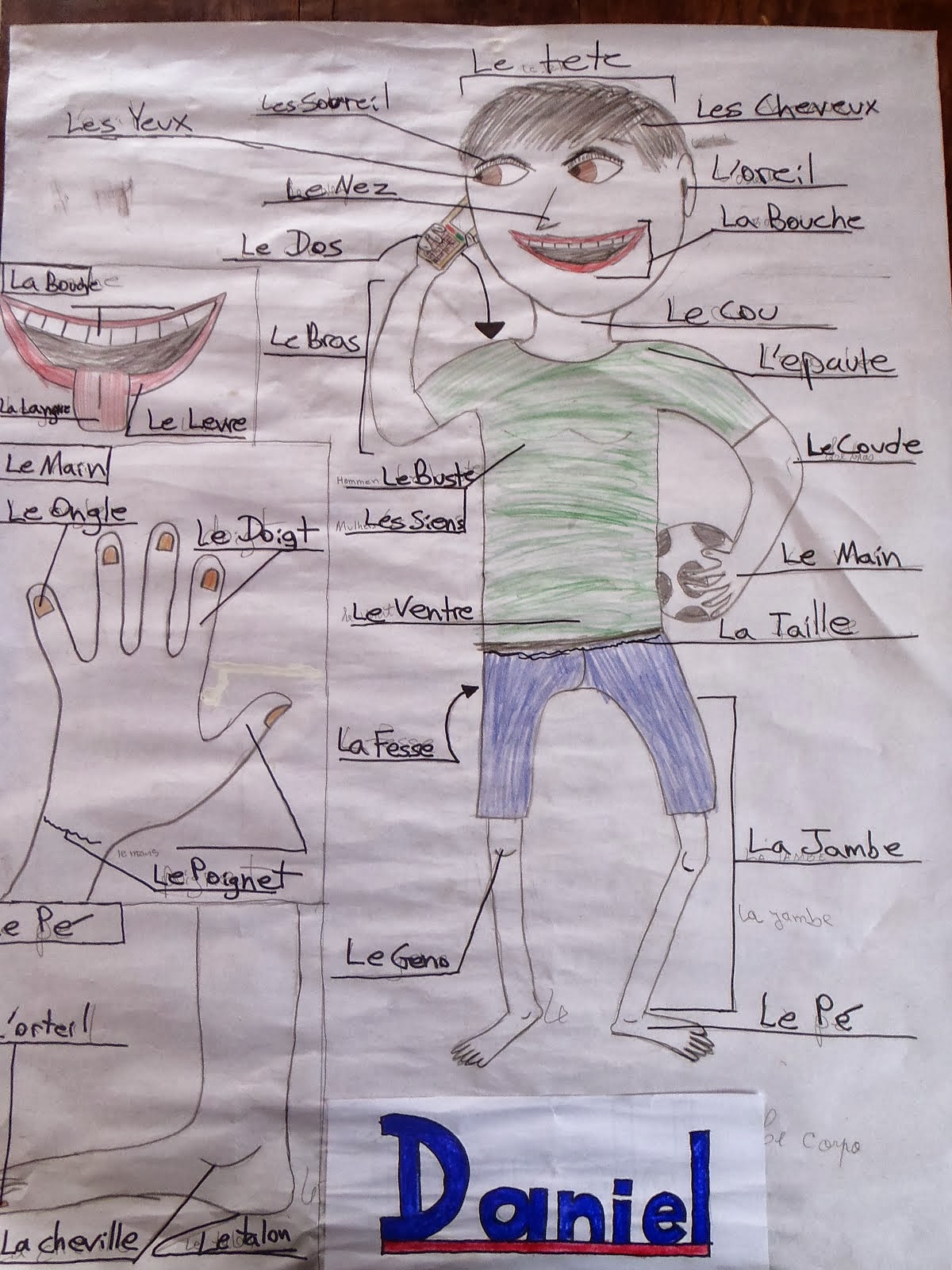
That’s why I have been looking forward to this week’s vocabulary topic: body parts. Beyond being able to tell my students “met ton fesse dans cette chaise maintenant!” (put your ass in that chair now!), it also meant that I could teach them one of my favorite games: Simon Says. But since it’s going to be in French, I knew that “Simon Dit” needed the brilliant linguistic powers of alliteration to have the same level of catchiness. Rolling through possible names in my mind, I saw the immense impact this decision would have. They don’t own twister. I can’t imagine they play “Pin the Tail on the Burro”. And it could be a while before Mr. Patata Cabeca is widely available in this country. This is going to be the defining body part related game for most of these students! I’m not just naming a classroom activity; I’m naming an essential part of their child/adolescent/adult-hood.

With the heavy weight of this decision resting on my shoulders, I thought about every name starting with “D” and its significance. Doris wouldn’t Portugafy well. Desmund goes hand in hand with Tutu. Deborah has too much history. Dylan belongs to Bob. Each name presented association problems that disqualified it. Then it came to me. How could I not have thought of it before? The learning-body-parts-in-French game should be known by the name of the French speaking father of the teacher who introduced it: my dad Daniel Bar.

Having now put this mission critical question to bed, I proceeded to draw up my teaching tool on papel gigante (giant paper), list the body parts I wanted to identify in egnlish, find them in my Portuguese dictionary, find them in my French dictionary, and copy them down. After a quick review to be sure I would remember where le talon (heel) and le poignet (wrtist) are, it was off to my 3 night classes.

Normally I expect my night classes to be quiet and slow. Getting my mostly tired and uninterested adult students to participate is like pulling teeth. But this time, they were animated, participatory, and engaged. Though I thought that the lesson would take the full hour and a half, students were so involved that we breezed through the material and were out in an hour. On the next day, I played Daniel Dit in my 3 afternoon classes. As opposed to the night classes, these students are mostly curious and excited teenagers, where class participation has never been a problem. So when I tell you that the resulting competitive atmosphere made the lessons a little too exciting at points, you should know that I’m not some old curmudgeon yelling at “them darn kids”. During my last and final lesson, I ended up have to draw a line on the floor with chalk, just so that the crowd of students trying to push forward wouldn’t overrun my position at the blackboard.

Next week we’re staring each lesson with a “Daniel Dit” contest, where if you mess up, you sit down. Last man (or woman) standing has been promised a prize, I thinking one of the precious fun-sized Snickers I brought with me. Maybe I Body ask Tojo to escort me to class in case things get out of hand….
---------------------------------------------------------------------------------------------------------------
Coco and Poco update: They said it wasn't possible. I thought it had reached its zenith. All indication showed that it was all downhill from here. But Poco has proven me wrong. She can, and will, get cuter and more adorable every day. Forgetting the times where she pees on my floor, her infinite curiosity and playfulness make her a pleasure to have in the house. And now that I’ve finally gotten the smell out of the sheets, I’m very pleased with Coco’s surprise.

Wednesday, February 15, 2012

The Wok and the Boy


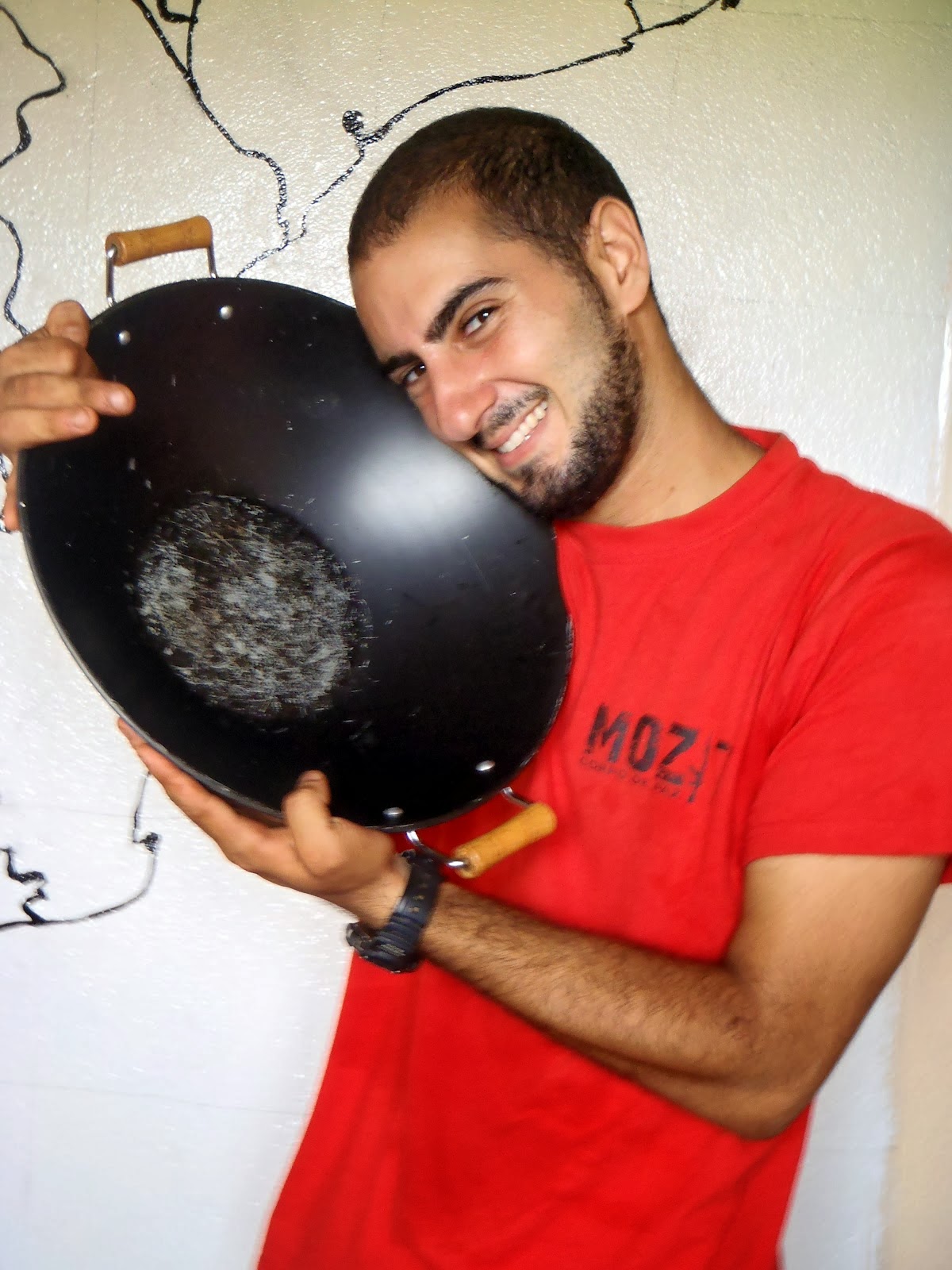
Once upon a time there was a wok. And this wok, unlike all the other woks, was sitting unused on the sandy steps of a Loja (store) in Alto Molocue, and it was lonely. No one wanted to use it to make delicious food, and it just sat on the step all day getting dusty. Then one day, a lovely boy from New Jersey, who happened to be living in the town, found the wok. He wanted the wok so bad, but didn’t have the money to pay for it, so he had to leave the wok on the sandy step. The wok was very sad, for once again it was alone to just sit on the sandy step all day getting dusty. But two days later, who should show up, but the lovely boy from New Jersey! No sooner than you could say “I’m gonna eat so much fried rice, it’s ridiculous,”  the wok had been washed, paid for, and put in the backpack of the lovely boy from New Jersey. After a short and dark trip, the wok arrived at the lovely boy from New Jersey’s house, and they made egg fried rice happily ever after.

The End

-----------------------------------------------------------------------------------------------------------------


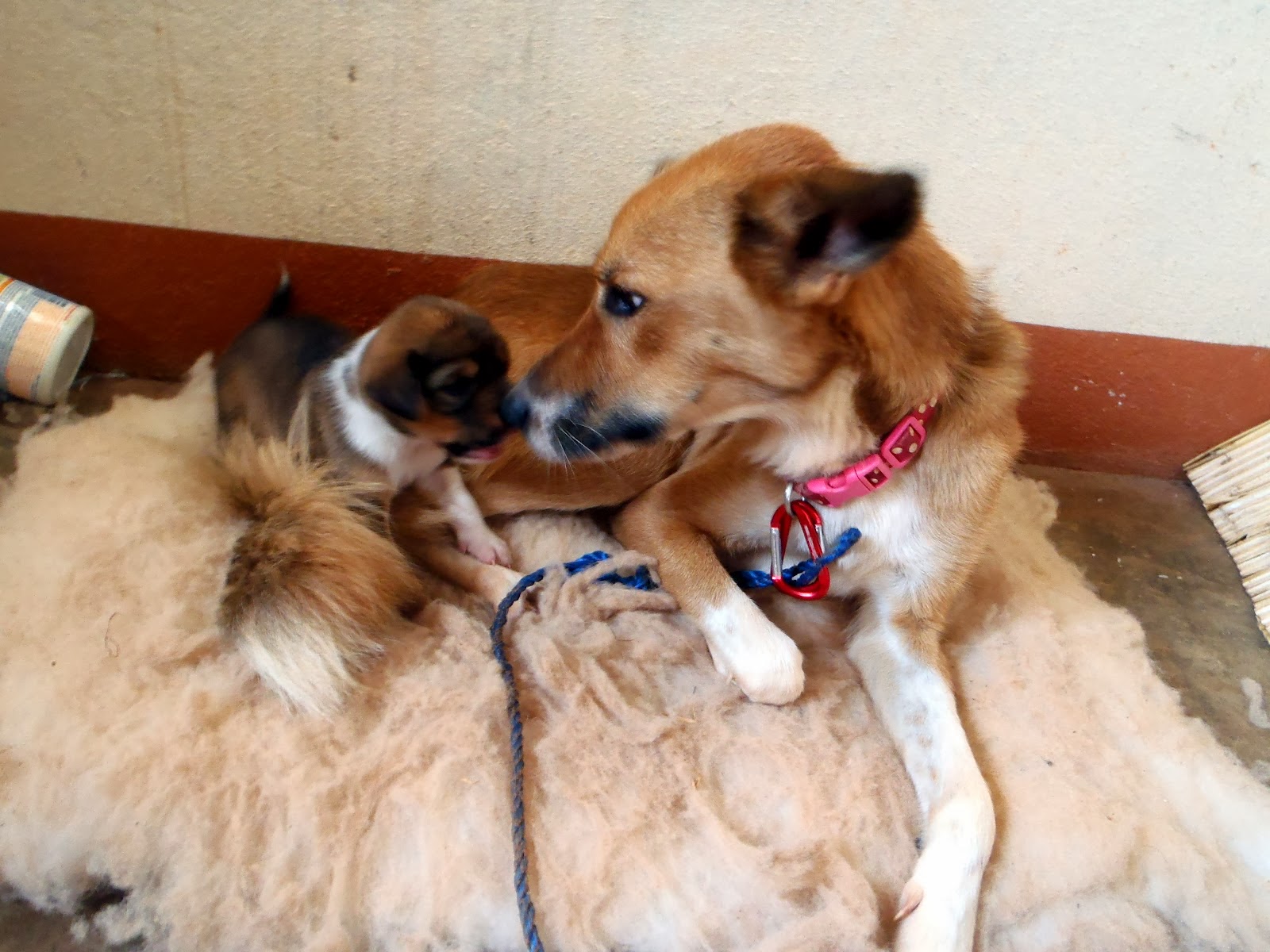
Coco and Poco Update: The newly named Poco (misspelling of little) has opened her eyes and is walking around. Yesterday, I mistakenly decided to give Coco her dinner while she was feeding Poco. The moment I put the bowl of food on the ground, Coco stood up, walked over, and began to eat, Poco still attached. After maybe a second of hang time, Poco dropped to the ground with a squeak, being forced to wait to eat by height limitations.

Thursday, February 2, 2012

Arrive Late? Dance


Directors and Students
It started two weeks ago on the official dia de abertura (opening day) for the Escola Secundaria Geral de Alto Molocue. There, the directors of the school, many of the teachers, and a modest handful of students gathered under the trees behind the school for some speeches, songs, announcements, and all around pomp. Afterwards, we moved next to the main group of classrooms for a little pep talk from the director of the school, and my neighbor. Once he introduced the 3 new teachers (myself, another French teacher, and an English teacher), we than ran through the two rows of teachers that had formed, being hit on the head by each teacher as we passed. I love welcoming rituals. And then, that was it, we were dismissed.


Teachers and Students
Though I hadn't understood much of what was going on, it became apparent that this wasn't the actual start of school. Maybe it was that only 30 or so teachers were there, when I knew there were upwards of 80. Maybe it was that many of the speeches were using the conditional form when talking about the school, such as “this year , we will have three new teachers.” Or maybe it was that we still hadn't made a school schedule, formed turmas (classes), or received supplies. Either way, the opening day was really just a tease.

Over the next two weeks, I did a lot of hanging around and waiting. Waiting for the turmas to be formed so I could make the schedule. Waiting for the teachers to be told of their assigned classes so we could address any conflicts that arose. Waiting for my students to find out their schedule so that they would actually attend class. Waiting for the school handyman to figure out how to open the locked door to my classroom so I can try to teach the 5 students who showed up. Waiting, waiting, waiting.

And then, class time! This Monday January 30, 2012 at 7:20 PM Mozambique Standard Time (MST?), a minute that will forever remain in infamy, I finally became a teacher. The students of 11 A/B courso de noite (night classes) were my first victims. Since this is night school, most, if not all, of the students are older than me. But instead of trying to find the fine line between respecting them as adults and maintaining order, I had resolved that would just treat them as I would any other student and hope they play along. To start this, I introduced myself as Professor Samuel Bar, an American volunteer who arrived in Mozambique 4 months ago who after living in Portugese for all that time is now having to relearn and teach French. Then, I went into my painstakingly prepared “Regras de la Sala”
1.       Nos estamos aqui para aprender, voces como alunos, eu como professor
We are here to learn, you as students, me as professor
2.       Respecta os otrous alunos, so uma pessoa pode falar cada vez
Respect the other students, only one person talking at a time
3.      Si qereria entrar na sala tarde, precisara a danḉar
If you would like to enter the classroom late, you need to dance

As if I had planned it, just as the howls and laughs had died down after I finished writing the third rule, a timid man appeared at the door, looking to enter.

“Licensa, posso entrar la sala?”                                  “Excuse me, can I enter the class?”
“Alunos, que e a regra?                                               “Class, what is the rule?”
“PRECISA DANCAR!”                                                  “Dance monkey, dance!!”

Confused, disoriented, and embarrassed, he tried to make his way to a seat, but I had to establish that my rules weren't to be messed with.

“Nao, nao pode sentar, precisa dancar”           “Nice try buddy, but I’m serious.
                                                                                Dance monkey, dance!”
“Mais, eu nao pode”                                        “Why are you doing this to me?
                                                                                 I’m only a little late”
“Nao pode dancar? Como e possivel?             “Do you think I’m just trying to embarrass you? You 
Todos podem dancar. Ver”                                should know I have no shame. This skinny white kid is 
 gonna show you up and dance in front of the whole  class, and you will stand there and watch till you join  me. Dance monkey, dance!”
Finally he joined me in my little double snap, shoulder roll, and shuffle, and sat down to the cheers, laughter, and wonder of all his colleagues.

After we had all agreed to the rules, we moved on to our first French lesson: greetings.
           Bon Jour/Bon Nuit
           Je m’appelle ___________
           Je suis une etudiante de Franḉais

Every time I said it, they would repeat, gratefully avoiding the need for directions. I then had each student recite each phrase twice by themselves so we could work on pronunciation. Though it took almost 25 minutes to get through the entire 50 person class, it was well worth it. By the end of the lesson, everyone was able to say the phrases and were excited to actually learn a new language on the first day of class.

What seemed like a mili-second after my first class had started, the bell rang signaling my 45 minute lesson was up. By Tuesday night, I had done the lesson 5 more times, with more or less the same reactions from the students, though my Portuguese got cleaner each time and my funny lines were better planned. For a person who loves to retell jokes, regardless of how many times the audience has heard it before, 6 turmas with two lessons a week is like having the best set of stand-up gigs in the world.

So far, being a teacher has been awesome and I can’t wait to try out some of my more ridiculous and entertaining teaching ideas in the future.
--------------------------------------------------------------------------------------------------------------
Coco Update: 

The still unnamed pup is alive and has seems to have doubled in size since last week. The naming contest is still open for entries, so keep sending in your double O names.


Show these cats how to do dat down south dance
Dat we learned a lil too fast and bought it to da hood
And got da whole crew askin... 
Teach me how to dougie
Teach me, teach me how to dougie

“Teach Me How to Dougie”- California Swag District

P.S. I have to give my site Mate Dylan credit for the dancing rule. After one of our many delicious dinners, I lamented that I had not yet come up with a good punishment for arriving to class late. He fixed that problem like a pro.